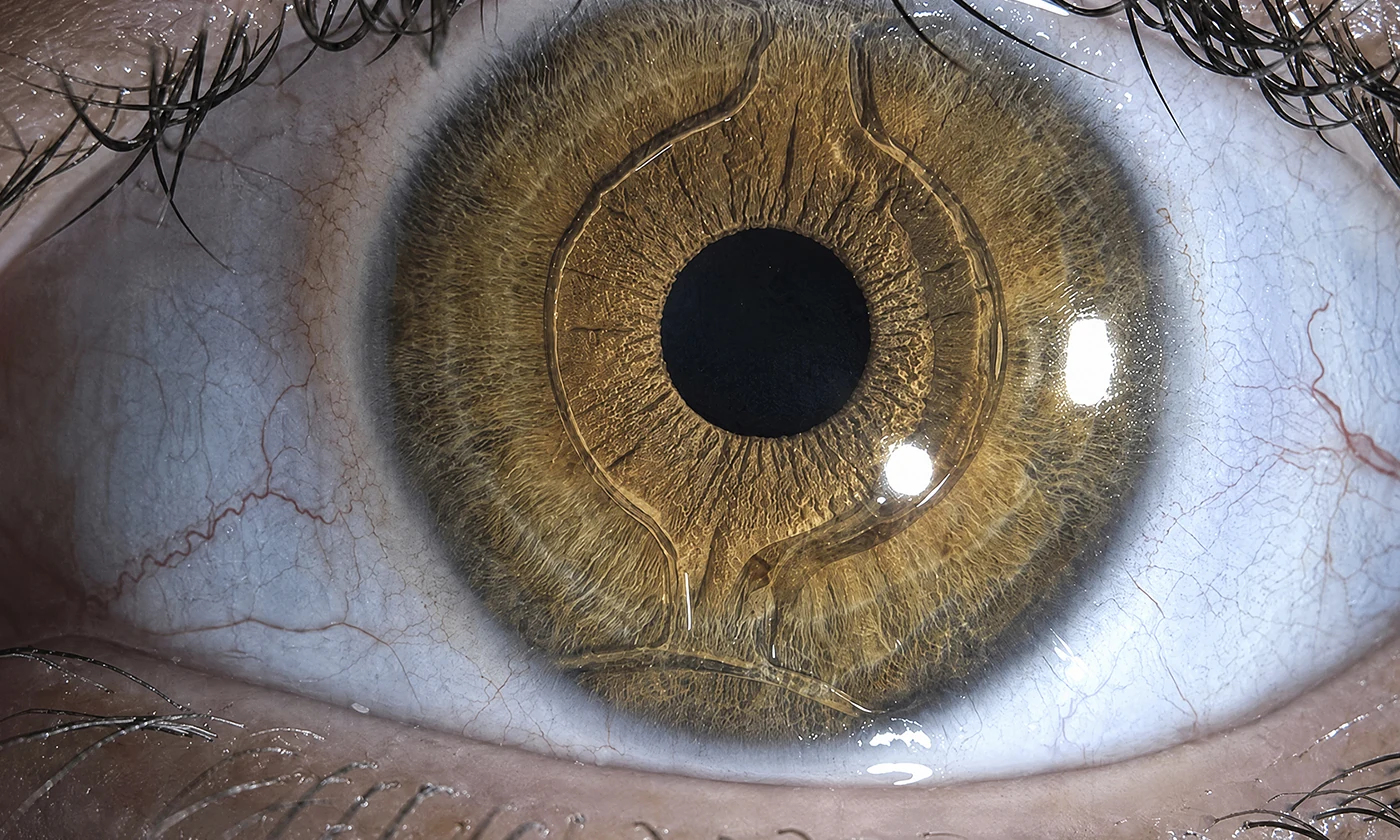
What Is a Phakic Intraocular Lens?
The phakic intraocular lens is a very thin, biocompatible lens implanted inside the eye, in front of the natural lens, to correct your prescription. The word “phakic” means exactly that: the eye keeps its own natural lens, unlike cataract surgery, where that lens is replaced.
Think of it as a permanent contact lens, but placed inside the eye. It corrects myopia, hyperopia, and astigmatism without removing or reshaping any corneal tissue, and it’s reversible.
When It’s the Best Option
Laser surgery (LASIK, SMILE, or surface ablation) corrects your prescription by thinning and reshaping the cornea. That works great for most cases, but it has a limit: at very high prescriptions it would mean removing too much tissue, and thin corneas don’t leave a safe margin.
A phakic lens is built for exactly those cases:
- High prescriptions of myopia, hyperopia, or astigmatism, outside the safe range for laser surgery
- Thin corneas or corneal topography that rules out laser surgery
- Patients who want a reversible solution
- Younger patients who want to keep their near focus, since the natural lens stays intact
Clinical Criteria
A phakic lens is generally a good fit for patients who are:
- Ages 21 to 45, approximately
- Stable prescription over the past 12 months
- Have adequate anterior chamber depth (the internal space of the eye) to hold the lens
- Have a healthy endothelial cell count
- In good overall eye health, with no uncontrolled glaucoma or other contraindications
Advantages Over Laser Surgery
| Feature | Phakic Lens | LASIK / SMILE |
|---|---|---|
| Touches the cornea | No | Yes, reshapes it |
| Reversible | Yes, can be removed | No, permanent |
| Very high prescriptions | Ideal | Limited |
| Thin corneas | Ideal | Limited or contraindicated |
| Keeps the natural lens | Yes | Yes |
| Post-op dry eye | Uncommon | Possible, temporary |
The Procedure, Step by Step
- Preoperative evaluation: complete testing that measures the internal size of the eye, the corneal endothelial cell count, your exact prescription, and overall eye health. This data is used to select the lens custom-sized for your eye.
- Day of surgery: an outpatient procedure with topical anesthesia (eye drops). You lie back while the team preps the eye.
- Lens implantation: through a microincision, the surgeon inserts the folded lens, which unfolds and settles into position behind the iris. No stitches required.
- Verification and discharge: the surgeon checks the lens position and eye pressure, and you go home the same day with post-op instructions.
Total time: about 20 to 30 minutes for both eyes.
Recovery
Recovery is fast and comfortable:
- Day 1: noticeable improvement in vision. Post-op checkup.
- First few days: back to normal activities, using antibiotic and anti-inflammatory drops as directed.
- First few weeks: vision fully stabilizes.
During the first few weeks, avoid rubbing your eyes, skip swimming, and wear sunglasses with UV protection. Your surgeon will give you exact timelines at your follow-up visits.
Why Choose Centro Láser for a Phakic Lens
At Centro Láser, we offer refractive surgery with the full range of advanced techniques: ReLEx SMILE, SBK LASIK, advanced surface ablation, and the phakic intraocular lens. That lets us recommend the technique that’s the best fit for your eye, not just the only one we happen to offer.
When your evaluation shows that laser surgery isn’t your best option, a phakic lens gives you back sharp, clear vision safely and reversibly, with internationally trained refractive surgeons and a complete pre-surgical protocol in a single visit.