What is myopia?
Myopia (from the Greek myops, “closed eye”), also called nearsightedness, is a refractive error in which light entering the eye focuses in front of the retina instead of on it. The result is blurry distance vision while near vision stays sharp.
Anatomically, myopia happens when:
- The eyeball is longer than normal (axial myopia, the most common form), or
- The cornea is more curved than it should be for the length of the eye, or
- Both at once.
Main symptoms
The signs that usually bring people in for an eye exam include:
- Blurry vision at a distance (street signs, the board at school, screens across the room)
- Needing to squint to focus on far-away objects
- Eye strain or headaches after driving or watching a movie
- Children may sit very close to the TV or struggle in school with anything that requires seeing the board
Prevalence and global trend
Myopia has become the most common eye condition of the 21st century. According to the World Health Organization and a range of epidemiological studies:
- Between 30% and 40% of the world’s population is nearsighted.
- By 2050 it is projected to reach 50% of the population.
- Prevalence is especially high in Asia (up to 80-90% in some countries).
- The rise is tied to modern lifestyles: less time outdoors and more close-up activities (reading, screens).
In the Dominican Republic, while we don’t have specific epidemiological figures, we’ve seen a steady increase in myopia diagnoses in children and teens over the last two decades.
Causes and risk factors
Myopia has a clear genetic component (children of nearsighted parents are more likely to be nearsighted too), but environmental factors are decisive in how it appears and progresses:
- Long stretches of close-up focus (reading, tablets, and phones held closer than about 12 inches)
- Little time outdoors (exposure to natural light plays a protective role)
- Progression during adolescence, along with the eye’s growth
- Genetic predisposition (inherited)
Classification by degree
Myopia is measured in negative diopters. A common classification:
- Mild myopia: up to -3.00 D
- Moderate myopia: -3.00 to -6.00 D
- High myopia: -6.00 to -10.00 D
- Extreme (pathologic) myopia: more than -10.00 D (with a higher risk of associated eye complications)
Complications of high myopia
Above -6.00 diopters, and especially in extreme myopia, there is a higher risk of:
- Retinal detachment (the elongated eye puts tension on the retina)
- Myopic macular degeneration
- Early cataracts
- Open-angle glaucoma
For this reason, people with high myopia need a full eye exam every year, including a dilated retinal exam, even when their corrected vision is stable.
Correction options
Optical correction
- Glasses: the safest and most versatile solution. Today’s lenses are thin even for strong prescriptions.
- Soft contact lenses: comfortable and effective for low to moderate prescriptions.
- Rigid gas-permeable (RGP) lenses: useful for irregular astigmatism or complex corneas.
- Orthokeratology: rigid lenses worn overnight that reshape the cornea while you sleep, useful for myopia control in children.
Surgical correction
Refractive surgery can give the right candidates lasting freedom from glasses:
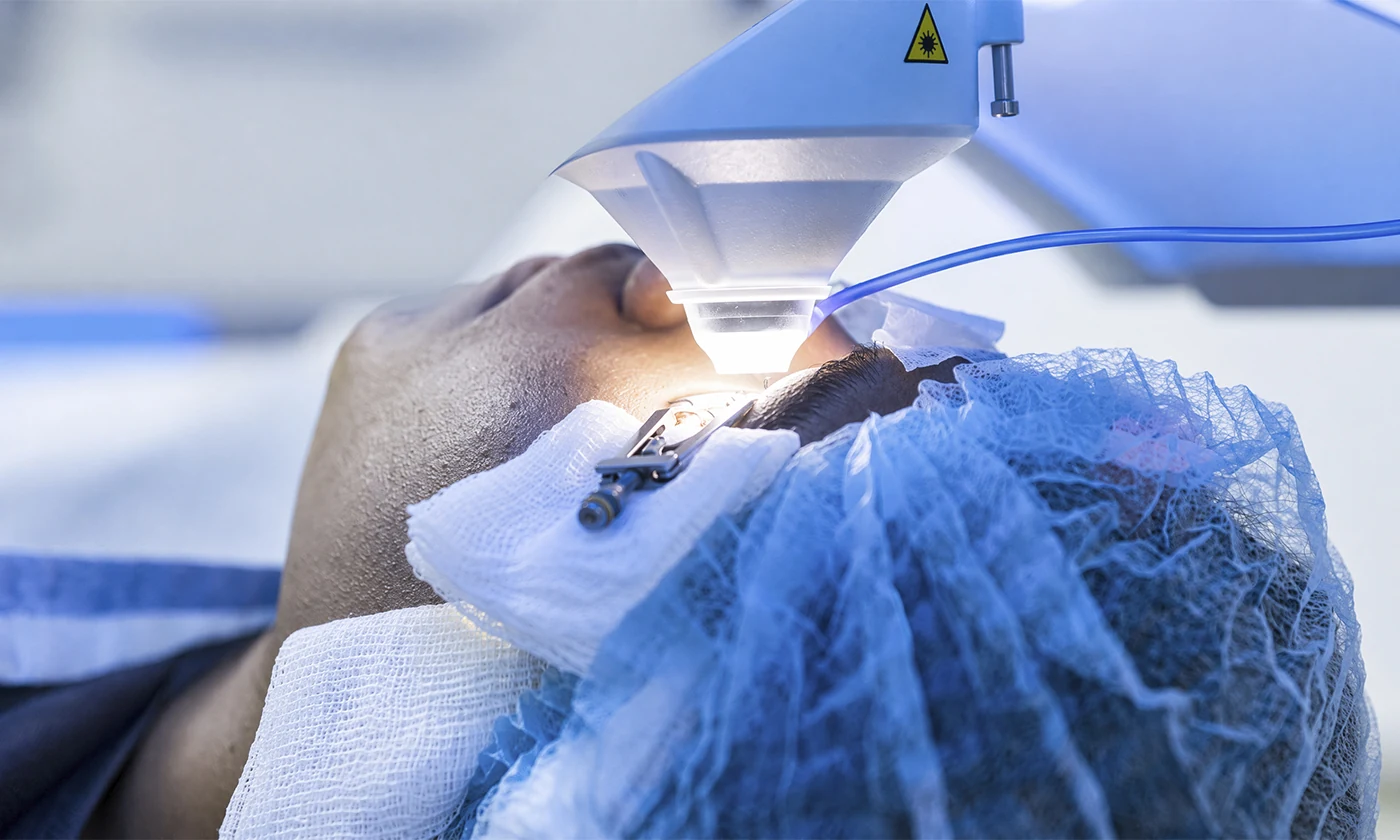
- ReLEx SMILE: a minimally invasive, flapless technique, ideal for active patients or those with dry eye
- LASIK: a well-established technique with excellent results, available when SMILE isn’t the primary indication
- PRK: a surface technique, useful for thin corneas or contact-heavy professions (military, athletes)
- Phakic intraocular lenses (ICL): for very high myopia or corneas not suited to laser surgery
- Lens replacement: for older patients where an early cataract makes corneal refractive surgery redundant
Myopia control in children
When we find progressing myopia in a child (more than -0.50 D of increase per year), there are specific treatments to slow it down:
- Low-dose atropine drops (0.01% to 0.05%): the treatment with the strongest current scientific evidence
- Myopia-control contact lenses (soft multifocal design)
- Overnight orthokeratology
- Myopia-control glasses (DIMS, MiYOSMART, and similar designs)
When to see a doctor
We recommend an eye exam if:
- Your child sits very close to the TV, squints to see far away, or is struggling in school with anything that requires distance vision.
- Your prescription has changed noticeably in the last 12 months.
- You see flashes of light, floaters, or shadows in your field of vision (an emergency, because of a possible retinal detachment).
- You have high myopia and haven’t had an exam in more than a year.
At Centro Láser we have state-of-the-art technology and specialists in refractive surgery, cornea, and retina for the complete management of myopia at any stage of life.