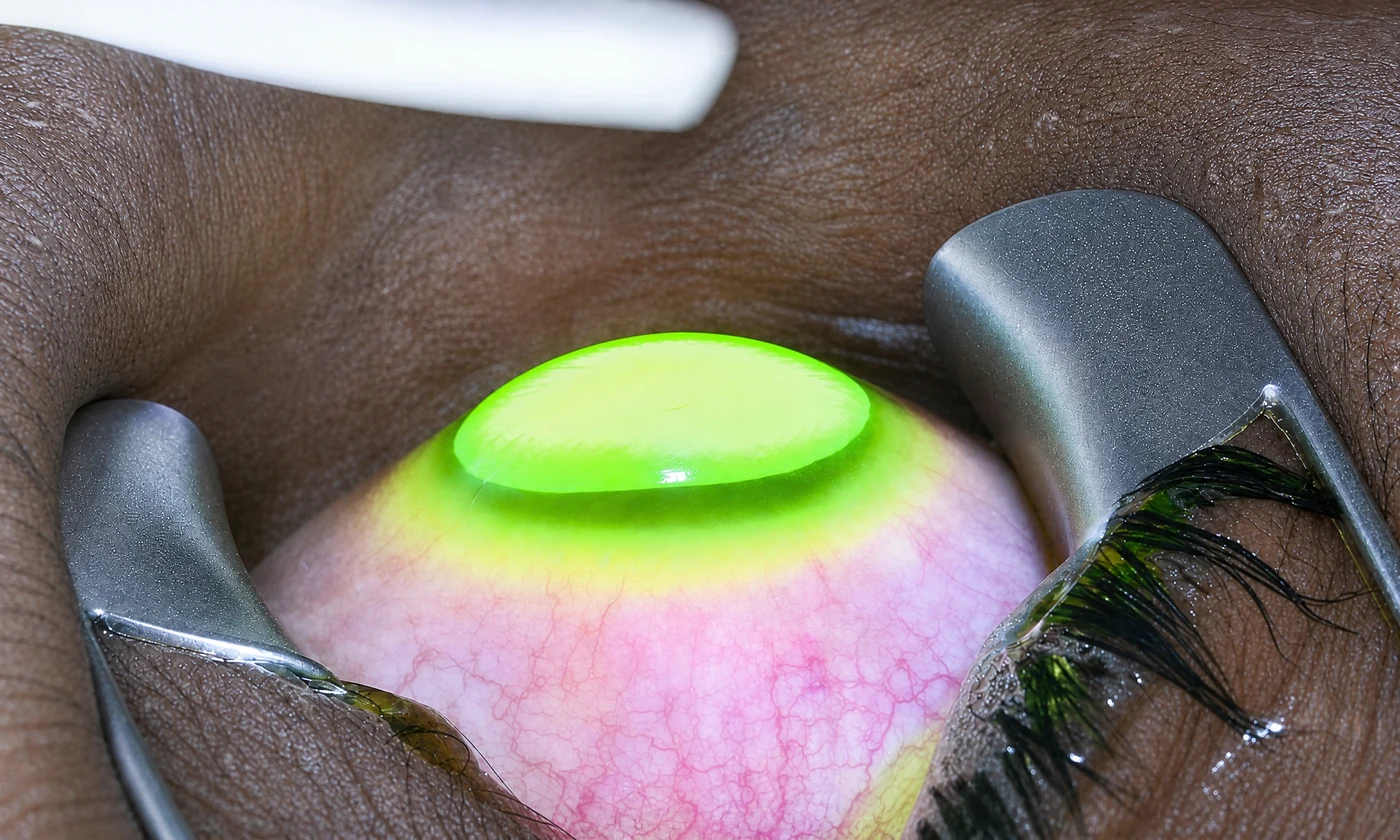
What Is a Corneal Transplant?
A corneal transplant (keratoplasty) is surgery that replaces a damaged, clouded, or deformed cornea with healthy corneal tissue from a donor. It’s the last step in corneal treatment, reserved for cases where vision can’t be restored with cross-linking, corneal rings, specialty lenses, or other treatments.
The big shift in modern ophthalmology is that the whole cornea no longer always needs replacing. Today, depending on which layer is damaged, surgeons can replace only the affected layer, preserving the rest of the patient’s own healthy cornea. This means faster recovery and a lower risk of rejection.
Types of Corneal Transplant
The cornea has several layers, and the technique is chosen based on which one is affected.
Penetrating Keratoplasty (PKP)
Replaces the full thickness of the cornea. It’s the classic technique, used when the damage affects all layers (deep scarring, very advanced keratoconus with scarring). It requires sutures that are removed gradually, and full visual recovery takes months.
Deep Anterior Lamellar Keratoplasty (DALK)
Replaces the outer and middle layers while preserving the patient’s own healthy inner layer (the endothelium). Used for keratoconus and scarring that doesn’t reach the deeper layers. Because the patient’s own endothelium is preserved, the risk of rejection is lower than with a full-thickness transplant.
Endothelial Transplants (DMEK and DSAEK)
Replace only the innermost layer of the cornea (the endothelium), which is what fails in many corneal dystrophies and after corneal decompensation from previous surgeries. These are the newest techniques:
- DMEK: replaces an ultra-thin layer, with the best visual recovery and the lowest rejection rate
- DSAEK: similar, but with a slightly thicker layer, which makes it technically simpler in certain cases
Both recover in weeks, not months, with a lower rejection risk than a full transplant.
Clinical Indications
A corneal transplant is appropriate for patients with:
- Very advanced keratoconus with thinning or scarring
- Corneal scarring from infections or trauma
- Inherited corneal dystrophies that affect corneal clarity
- Endothelial failure (corneal decompensation)
- Rejection or failure of a previous transplant
The Process
- Complete evaluation: topography, pachymetry, specular microscopy, anterior segment OCT, and an assessment of the ocular surface.
- Donor tissue coordination: sourced through a certified eye bank, with rigorous tissue screening.
- Surgery: local anesthesia with sedation, or general anesthesia. The technique used (PKP, DALK, DMEK, or DSAEK) depends on the diagnosis. The procedure takes 45 to 90 minutes.
- Immediate post-op care: an eye shield and rest, along with corticosteroid and antibiotic drops.
- Extended follow-up: close monitoring to watch the graft, prevent rejection, adjust sutures (for PKP), and fine-tune the final prescription.
Recovery
Visual recovery depends heavily on the technique:
- DMEK / DSAEK (endothelial): functional vision within weeks
- DALK (lamellar): months, depending on healing
- PKP (penetrating): months, with sutures removed gradually
In every case, the final prescription may call for glasses or contact lenses, and follow-up continues over the long term to watch for rejection, which is manageable with drops when caught early.
Why Choose Centro Láser for a Corneal Transplant
Centro Láser has a cornea department with dedicated fellowship-trained subspecialists, including transplant surgeons experienced in every modern technique, from classic penetrating keratoplasty to endothelial DMEK and DSAEK. We work with certified eye banks and provide the extended follow-up a transplant requires. For cases where a conventional transplant isn’t an option, we offer keratoprosthesis (K-PRO).