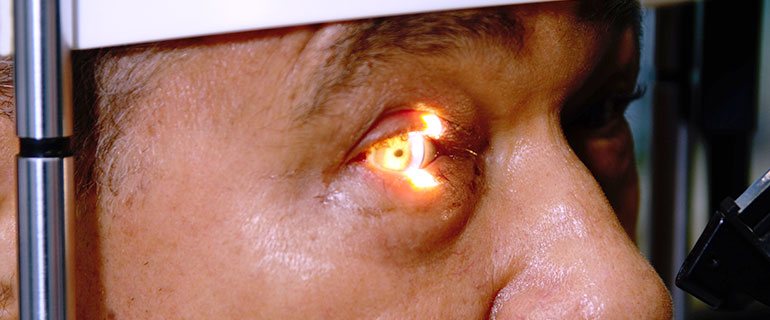
What Is Selective Laser Trabeculoplasty?
SLT (selective laser trabeculoplasty) is an outpatient laser procedure used to treat open-angle glaucoma. It applies short, low-energy laser pulses to the trabecular meshwork, the microscopic structure in the eye responsible for draining aqueous humor. This stimulation improves the meshwork’s drainage capacity, lowering intraocular pressure without damaging the surrounding tissue.
It’s an established technique with more than 20 years of clinical use, backed by large clinical studies, including the LiGHT trial (2019), which showed that SLT can be as effective as pressure-lowering eye drops in newly diagnosed patients.
Why SLT Instead of Other Options?
SLT offers concrete advantages over other treatments:
- Versus eye drops: eliminates or reduces the need for daily drops, avoids ocular and systemic side effects, and improves adherence, since it doesn’t depend on the patient remembering to use them
- Versus the older ALT laser: doesn’t cause thermal scarring of the tissue, so the procedure can be repeated without harming the eye
- Versus surgery: it’s outpatient, done with anesthetic drops, involves no significant recovery time, and carries none of the risks of incisional surgery
Clinical Indications
SLT is appropriate for patients with:
- Open-angle glaucoma, primary or pseudoexfoliative
- Ocular hypertension without visible optic nerve damage yet
- Newly diagnosed patients who prefer to avoid daily eye drops
- Patients who struggle with adherence to drop-based treatment
- As an add-on when drops aren’t controlling target pressure
Contraindications
SLT isn’t recommended for:
- Angle-closure or narrow-angle glaucoma (where YAG laser iridotomy is preferred)
- Active neovascular or uveitic glaucoma
- Advanced cases requiring direct incisional surgery
- Cloudy or opaque corneas that prevent visualization of the angle
The Procedure, Step by Step
- Pre-procedure evaluation: tonometry, gonioscopy, and optic disc OCT to confirm the indication.
- Day of the procedure: topical anesthesia with eye drops. A special lens is placed on the cornea to focus the laser.
- Laser application: short, selective pulses to the trabecular meshwork, taking about 10 minutes per eye.
- Immediate observation: intraocular pressure is measured right after the procedure. You’re discharged the same day with instructions.
Recovery and Follow-Up
In the first few hours you may notice:
- Light sensitivity
- A mild gritty feeling
- Slightly blurred vision
These symptoms clear up within hours. An anti-inflammatory eye drop is prescribed for a few days.
Follow-up visits:
- 1 week: pressure check and inflammation screening
- 4 to 6 weeks: pressure check to evaluate your response to treatment
- 3 months: confirmation of sustained pressure reduction
- Regular glaucoma follow-up every 3 to 6 months
Why Choose Centro Láser for SLT
Centro Láser has a dedicated glaucoma department with fellowship-trained subspecialists focused specifically on the long-term management of this condition. Before scheduling SLT, we run a complete evaluation: tonometry, pachymetry, gonioscopy, optic disc OCT, and Humphrey visual field testing, to confirm the procedure is the best option for your case. Follow-up care after the procedure stays fully integrated into your ongoing glaucoma management, with no referrals to outside centers.