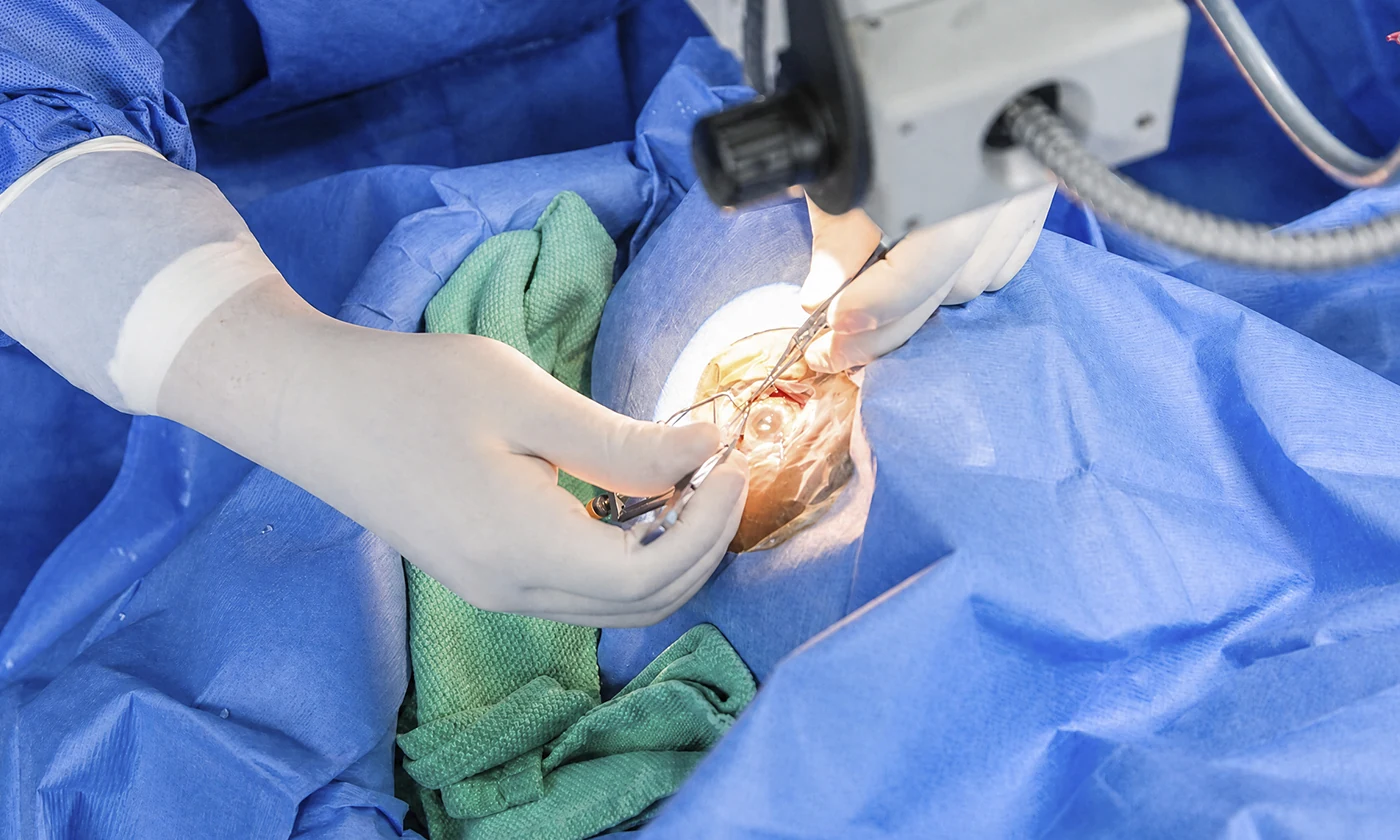
When Is Glaucoma Surgery Necessary?
Glaucoma surgery comes into play when less invasive treatments can no longer control eye pressure. This happens in a few different situations:
- Eye drops aren’t reaching the pressure target your specialist has set for you
- Laser procedures (SLT, YAG iridotomy) haven’t provided enough control
- Optic nerve damage keeps progressing despite treatment, as shown by OCT and visual field testing
- You can’t tolerate the drops, or have trouble sticking with the regimen
- Advanced cases where surgery is the only option left to preserve remaining vision
Available Surgical Options
Centro Láser offers every modern glaucoma surgery technique. The right choice depends on the type of glaucoma, how advanced it is, your eye anatomy, and your overall health.
Trabeculectomy
The classic glaucoma surgery technique, in use for more than 50 years. It creates a controlled opening in the sclera (the white part of the eye) that lets aqueous humor drain into a space under the conjunctiva, forming a small drainage bleb. It’s highly effective, but it calls for close follow-up in the first few weeks.
Drainage Implants (Valves)
Small devices implanted in the eye that drain aqueous humor through a tube to a reservoir. The two most widely used are:
- Ahmed valve: has a flow-restricting mechanism that lowers the risk of early hypotony
- Baerveldt implant: no valve, a larger reservoir, and stronger pressure-lowering power, though it requires careful flow management in the first few weeks
These are used for complex glaucomas, refractory cases, neovascular glaucoma, or when a previous trabeculectomy has failed.
MIGS (Minimally Invasive Glaucoma Surgery)
Modern procedures that lower eye pressure through smaller incisions, less tissue manipulation, and faster recovery. They carry a better safety profile, though the pressure reduction tends to be more modest. MIGS works well for mild to moderate glaucoma, and it’s often combined with cataract surgery.
Clinical Indications
Glaucoma surgery is appropriate for patients with:
- Advanced glaucoma with documented optic nerve damage
- Eye pressure that isn’t controlled with drops and/or laser treatment
- Progressive damage on OCT or visual field testing despite treatment
- Poor tolerance of, or adherence to, eye drops
- Refractory cases or complex secondary glaucomas
Contraindications
We don’t recommend surgery for:
- Glaucoma that’s controlled with less invasive treatment
- End-stage cases with no visual potential left to preserve
- Active eye infection or intraocular inflammation
- Systemic health conditions that rule out elective surgery
The Procedure, Step by Step
- Complete pre-surgical evaluation: tonometry, gonioscopy, pachymetry, optic nerve OCT, visual field testing, biometry, and general health exams based on your age and other conditions.
- Day of surgery: local anesthesia plus light sedation. This is an outpatient procedure, sometimes with brief observation afterward.
- Surgical technique: depends on the option chosen (trabeculectomy, valve implant, or MIGS). It takes 45 to 90 minutes per eye.
- Closing and bandaging: your eye is patched for the first 24 hours.
- You go home the same day with detailed instructions.
Recovery and Aftercare
First 48 hours:
- Manageable discomfort with pain relievers
- A gritty, foreign-body sensation
- Tearing
- Blurry vision is expected
First week:
- Relative rest (no strenuous activity, bending over, or lifting)
- Antibiotic, anti-inflammatory, and dilating drops as prescribed
- Keep water out of your eye, don’t rub it, and skip makeup
Close follow-up schedule:
- Day 1, day 3, day 7
- Weeks 2 and 4
- Monthly for the first 3 months
- Then standard glaucoma follow-up every 3 to 6 months
With trabeculectomy and valve implants, your surgeon may need to adjust sutures or release flow during an office visit to fine-tune the pressure in the first few weeks.
Why Choose Centro Láser for Glaucoma Surgery
Centro Láser has a dedicated glaucoma department staffed by fellowship-trained subspecialists in modern surgical techniques. We offer every option: trabeculectomy, Ahmed and Baerveldt implants, and MIGS procedures. A complete pre-surgical evaluation lets us choose the technique with the best risk-benefit ratio for each case. Post-operative follow-up is close and folds directly into your ongoing glaucoma care, with no need to be referred elsewhere.