What Is Femtosecond Laser Cataract Surgery?
Femtosecond laser-assisted cataract surgery (also known as FLACS, or Femtosecond Laser-Assisted Cataract Surgery) is a technological evolution of traditional phacoemulsification. Instead of the surgeon manually performing the procedure’s first steps, an ultra-precise, computer-guided laser carries out those stages, guided by real-time imaging of the patient’s eye.
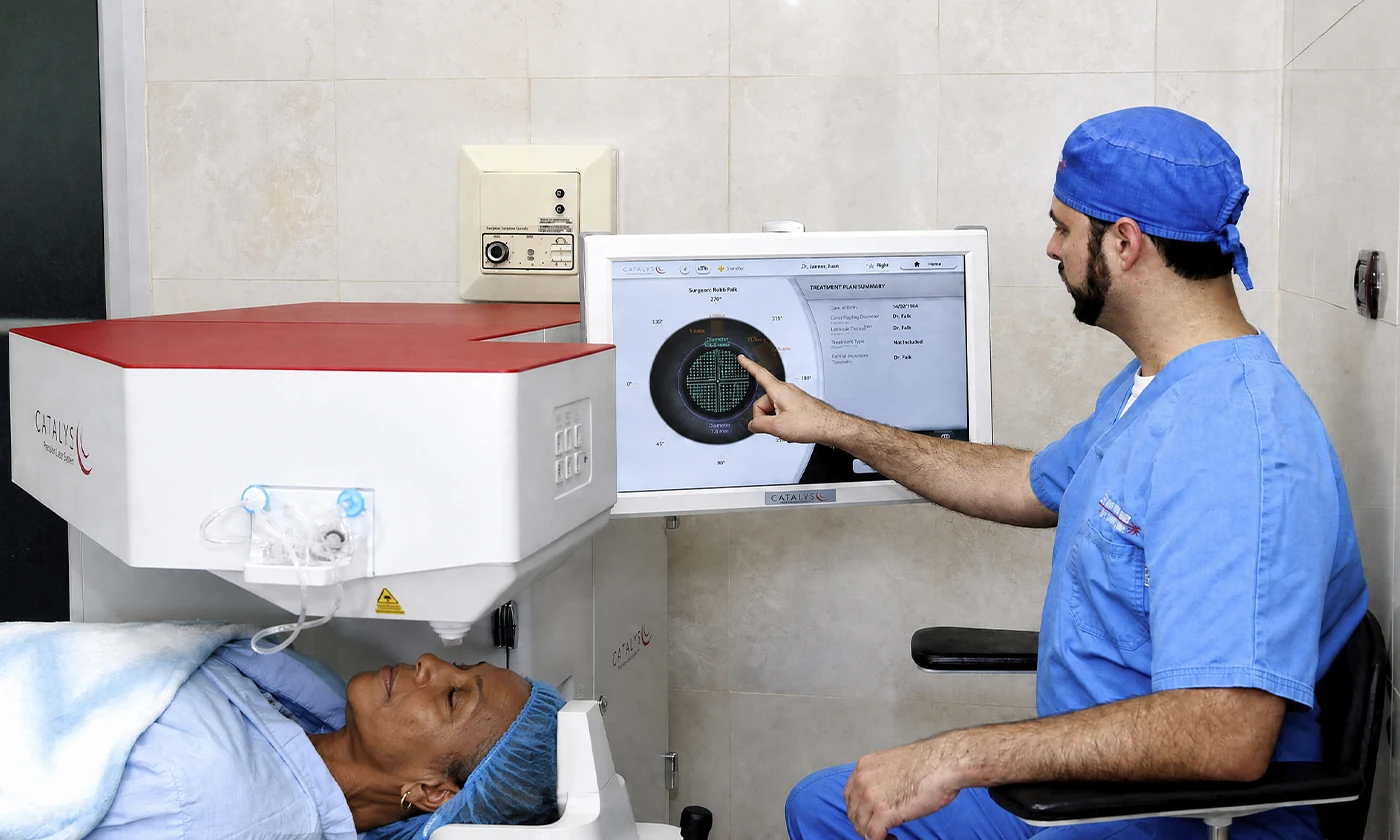
At Centro Láser, we perform this surgery with the Catalys® laser, an FDA-approved platform that combines integrated optical imaging to guide the cut with micron-level precision.
The laser-assisted steps are:
- The main corneal incision, plus relaxing incisions for astigmatism when needed
- The capsulorhexis (a circular opening in the front of the lens capsule)
- Lens fragmentation, dividing the lens into predefined sections to make removal easier
The final phase, removing the lens fragments and implanting the intraocular lens, is done using standard phacoemulsification technique.
This combination results in a cataract surgery with greater reproducibility, less ultrasound energy, and micron-level precision at every critical step.
First in Latin America and North America
Centro Láser was the first ophthalmology center in Latin America and North America to use femtosecond laser technology for cataract surgery, back in 2009. More than fifteen years of experience with the technology have made the center a regional reference point for this technique, training multiple generations of ophthalmologists in its clinical application.
That track record translates into deep hands-on experience, refined surgical protocols, and consistent results across a wide range of patient profiles, from standard cataracts to complex cases involving high astigmatism, compromised corneas, or premium visual expectations.
When Is Femtosecond Laser Surgery Recommended?
Traditional phacoemulsification remains the standard for most cases, but femtosecond laser surgery offers real advantages in specific situations:
-
Patients choosing a premium intraocular lens (multifocal, toric, trifocal, or EDOF). With these lenses, exact centration and a perfectly round capsulorhexis directly affect the final visual quality, and the laser’s precision optimizes the outcome.
-
Moderate to high corneal astigmatism. The laser can create precisely calibrated relaxing incisions to correct astigmatism during the same surgery.
-
Corneas with a fragile endothelium. By pre-fragmenting the lens, the laser significantly reduces the ultrasound energy needed, protecting the corneal endothelium.
-
Complex eye anatomy or dense cataracts. Pre-surgical laser capsulorhexis and fragmentation give the surgeon a more controlled starting point in cases where a manual approach would be technically demanding.
-
Patients who prefer the most technologically advanced option, regardless of how complex their case is.
Your specialist will help you determine whether your specific case would clinically benefit from this technology, or whether traditional phacoemulsification already offers the best solution for you.
Clinical Advantages Over Traditional Surgery
| Feature | Femtosecond Laser | Traditional Phacoemulsification |
|---|---|---|
| Corneal incision | Computer-guided laser, reproducible geometry | Done by hand by the surgeon |
| Capsulorhexis | Perfectly round, precise centration | Manual, with forceps |
| Lens fragmentation | Pre-done by the laser, in sections | Manual, with ultrasound |
| Ultrasound energy required | Significantly reduced | Standard |
| Intraoperative astigmatism correction | Available, with high precision | Limited to select cases |
| Approximate duration | 20-35 min per eye | 15-30 min per eye |
| Cost | Premium (additional copay) | Standard insurance coverage |
| Recovery | 1-2 days to resume normal activities | 1-2 days to resume normal activities |
The Procedure, Step by Step
-
Preoperative evaluation. A complete eye exam plus IOL Master biometry, specular microscopy, macular OCT, and, depending on your case, Pentacam and aberrometry. This evaluation determines whether you’re a good candidate for femtosecond laser surgery and which intraocular lens best fits your visual goals.
-
Day of surgery. You’ll arrive fasting. We apply dilating drops for an hour beforehand, followed by topical anesthesia plus light intravenous sedation.
-
Laser phase. In the first room, you lie back under the femtosecond laser. A soft interface docks your eye to the system, and the laser performs the corneal incision, the capsulorhexis, and the lens fragmentation in about 30 to 60 seconds. No cutting instrument ever touches the eye, the entire step is done by laser light guided by optical imaging.
-
Move to the surgical microscope. You’re moved to the operating table, where the surgeon continues with the phacoemulsification phase.
-
Lens removal. Through the incision already made, the surgeon aspirates the lens fragments the laser has already segmented. Less ultrasound energy is needed than in traditional surgery.
-
Intraocular lens implantation. The folded lens is inserted and unfolds inside the empty capsule. The laser’s perfectly round capsulorhexis makes it easier to center the lens exactly, which matters most with premium lenses.
-
Natural closure. The microincision seals on its own through natural adhesion. Drops are applied and the procedure is complete.
You’ll stay for a few minutes of observation and go home the same day with an eye patch, which comes off the next day.
Recovery and Aftercare
The recovery process is essentially the same as with traditional phacoemulsification. The difference between the two techniques lies in the surgery itself, not in how the eye heals.
First week:
- Antibiotic and anti-inflammatory drops as prescribed
- Don’t rub your eye or sleep on the side of the operated eye
- Avoid getting water directly in your eye (no pools, no ocean, no tilting your head back in the shower)
- No strenuous exercise or heavy lifting
- Wear sunglasses outdoors
Follow-up visits:
- Next day
- At 7 days
- At one month (final evaluation of the refractive outcome)
Vision fully stabilizes between 4 and 6 weeks. If both eyes need surgery, they’re scheduled 1-2 weeks apart.
Is Femtosecond Laser Surgery Worth It for You?
It’s an individual decision you make together with your specialist, based on three factors:
-
The type of intraocular lens you choose. If you go with a premium lens (multifocal, trifocal, or toric), femtosecond laser surgery maximizes the quality of your result. With a standard monofocal lens, the relative benefit is smaller.
-
The characteristics of your eye. Corneal astigmatism, cataract density, corneal endothelial health, and overall eye anatomy all determine whether your case would clinically benefit from the technology.
-
Your visual goals and budget. Femtosecond laser surgery involves an additional copay on top of standard surgery. For some patients, the precision and technology are worth the investment, for others, traditional phacoemulsification with an experienced surgeon delivers the same functional result at a lower cost.
At your preoperative consultation, we’ll talk through these factors with you and help you choose the option that best fits your case.
Why Choose Femtosecond Laser Cataract Surgery at Centro Láser
- Fifteen years of regional experience with the technology. We were the first in Latin America and North America to introduce it, in 2009.
- Catalys® laser (FDA-approved) with integrated optical imaging for micron-level precision.
- A team of refractive surgeons with international training in premium and femtosecond cataract surgery.
- Every presurgical test under one roof. Biometry, specular microscopy, OCT, Pentacam, and aberrometry, with no need to go elsewhere.
- A full catalog of premium intraocular lenses (monofocal, toric, multifocal, trifocal, and extended depth of focus) to pair with the laser’s precision.
- Proven protocols, backed by years of experience with the technique.
- Bilingual care and a personal touch that supports you and your family from your first evaluation through every follow-up visit.
If you’d like to find out whether you’re a candidate for femtosecond laser cataract surgery, you can request an evaluation with our specialists.