What Is Corneal Cross-Linking?
Corneal cross-linking (CXL, short for corneal collagen cross-linking) is a treatment that strengthens the cornea’s structure to stop the progression of keratoconus and other corneal ectasias. It’s the first line of treatment for stopping the disease when it’s caught early.
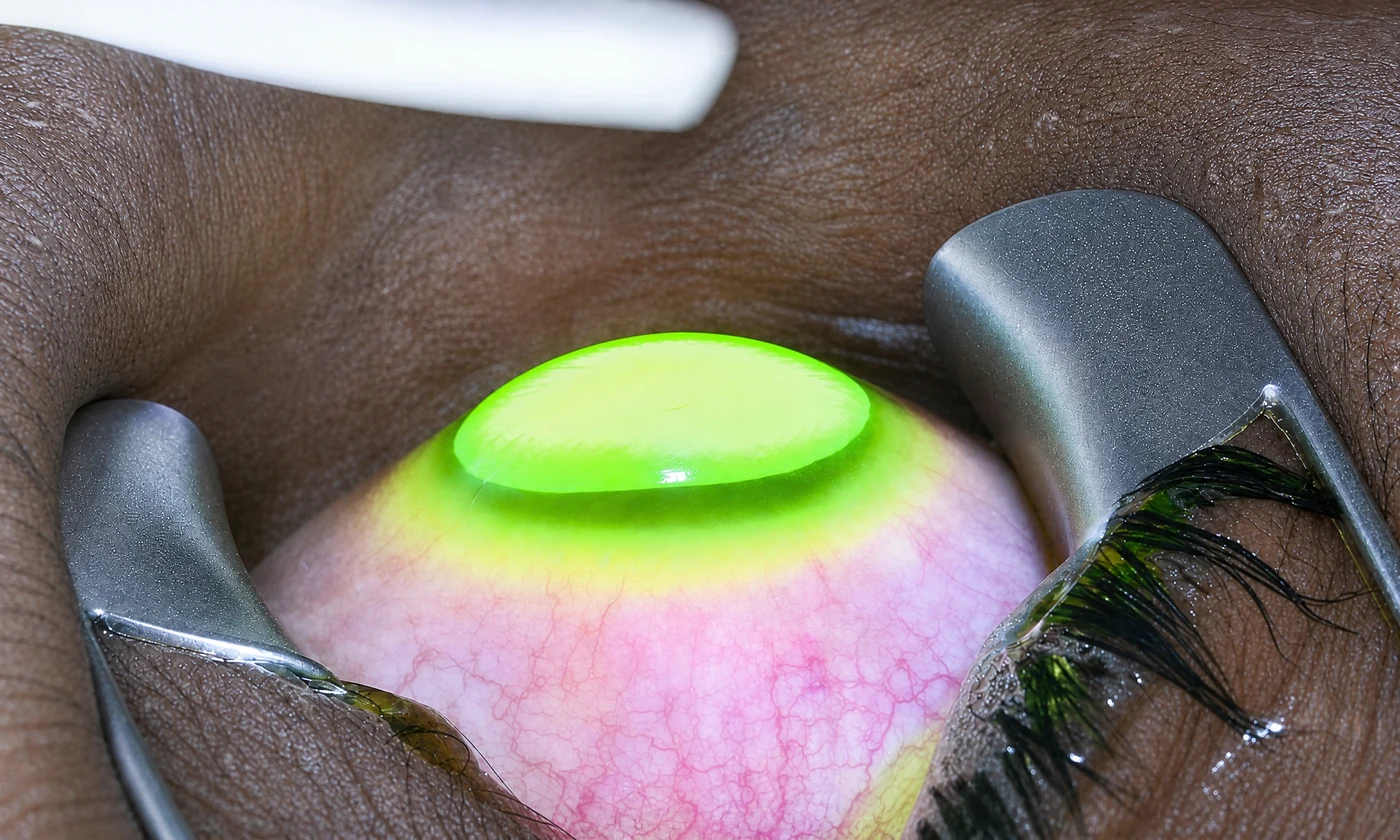
The procedure combines two elements: riboflavin (vitamin B2) drops and ultraviolet A (UV-A) light. The riboflavin saturates the cornea, and when it’s activated by the UV light, it forms new chemical bonds between the collagen fibers. These bonds act like bridges that stiffen and stabilize the cornea, halting its progressive deformation.
Why Timing Matters So Much
Cross-linking stops progression, it doesn’t reverse damage that’s already been done. This distinction is key:
- Applied early, it preserves the best possible vision and often avoids the need for a corneal transplant down the road
- Applied late, once the cornea is already badly deformed, it stops the progression, but the vision already lost doesn’t come back
That’s why, once keratoconus is confirmed to be progressing, especially in teens and young adults, where it tends to advance faster, cross-linking is recommended without delay.
Clinical Indications
Cross-linking is appropriate for patients with:
- Progressive keratoconus documented by corneal topography
- Corneal ectasia after refractive surgery (a rare complication of LASIK)
- Pellucid marginal degeneration and other primary ectasias
- Sufficient corneal thickness for the treatment to be safe (confirmed by pachymetry)
Contraindications
Cross-linking isn’t recommended when:
- The cornea is too thin for the standard protocol (variants exist for some cases)
- There’s significant central corneal scarring
- There’s an active eye infection
- There’s a history of poor corneal healing
Step-by-Step Procedure
- Pre-treatment evaluation: Pentacam corneal topography, pachymetry, and specular microscopy to confirm the indication and safe thickness.
- Day of the procedure: topical anesthesia with drops. The patient reclines comfortably.
- Surface preparation: in the standard technique (epithelium-off), the corneal epithelium is gently removed so the riboflavin can penetrate better.
- Riboflavin application: riboflavin drops are instilled for several minutes until they saturate the cornea.
- UV-A irradiation: ultraviolet light is applied for a controlled amount of time, activating the riboflavin and forming the new collagen bonds.
- Bandage contact lens: a bandage contact lens is placed to protect the cornea while the epithelium regenerates, along with antibiotic and anti-inflammatory drops.
The full procedure takes 60 to 90 minutes.
Recovery and Aftercare
For the first 2 to 3 days, while the epithelium regenerates, you may feel:
- Discomfort, burning, or a foreign body sensation
- Tearing and light sensitivity
- Temporary blurry vision
These symptoms are expected and ease as the surface heals. The bandage lens is removed at a follow-up visit, usually between day 3 and 5, and you’ll continue using drops as directed.
Visual recovery:
- Vision may fluctuate over the first few weeks
- The cornea keeps remodeling and stabilizing over the following months
- Follow-up topography confirms that the progression has stopped
Why Choose Centro Láser for Corneal Cross-Linking
Centro Láser has a cornea department with dedicated fellowship-trained subspecialists and precision diagnostics. Before cross-linking, we run a complete evaluation with Pentacam topography, pachymetry, and specular microscopy to confirm the treatment is safe and well-timed for your case. When appropriate, we combine it with intracorneal ring segments to not only stop the keratoconus but also improve vision, all within the same center.